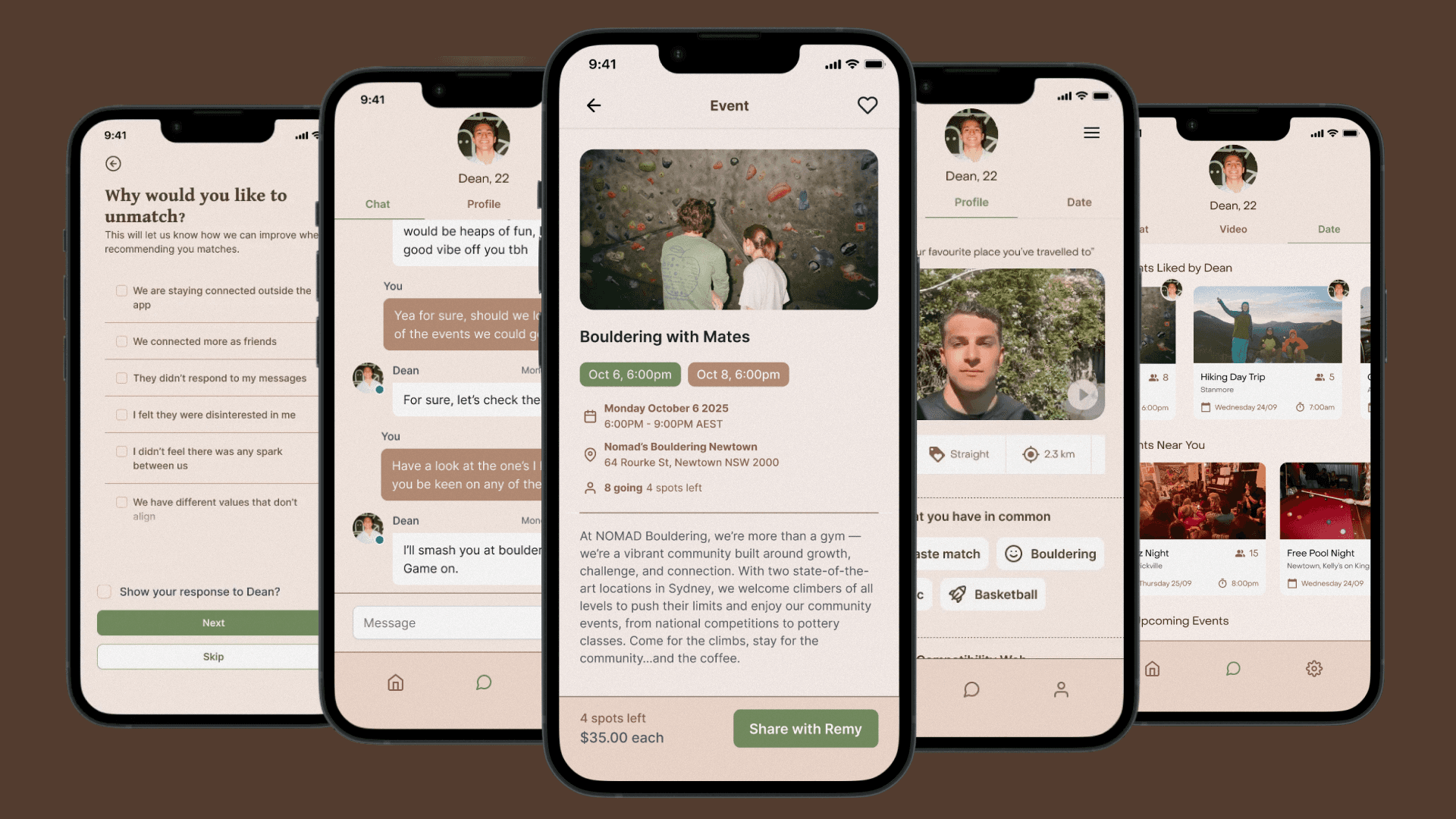
Circl
Digital connections rooted in real experiences
Capstone Project
Interaction Design
Mobile
Project Type
University
Role
Designer / UX Researcher
Timeline
3 months
Tools
Canva, Figma, Figjam, Figma Slides
Design methods / activities
Online Ethnography, Usability Testing, User Journey Mapping, HMWs, Personas, Data Analysis, Mobile Design, Marketing Strategy, Financial Modelling,
Collaborators
Kirita Geeves, Yasmine Harvey, Jessica Lee
Table of contents
Introduction to the problem
Design Solution
Development & Further testing
Final product
Introduction to the problem
The problem space
With the task brief of 'designing for transitions' our group was immediately drawn to discourse in our social circles with changes in romantic relationships and dating behaviours in relationship to the rise of technological advancements and social disruptions.
Existing solutions commodified dating with an endless cycle of swiping fueling gendered based resentment as women face safety concerns and harassment and men face endless cycles of rejection.
“Men outnumber women 3:1 on dating apps with male match rates averaging at 3%, transforming dating into a commodified marketplace of swipes and profiles. This highly competitive system subjects users to repeated cycles of rejection leading to resentment pushing people furt her into online communities, deepening division rather than fostering mutual understanding and authentic connections.”
Design rationale
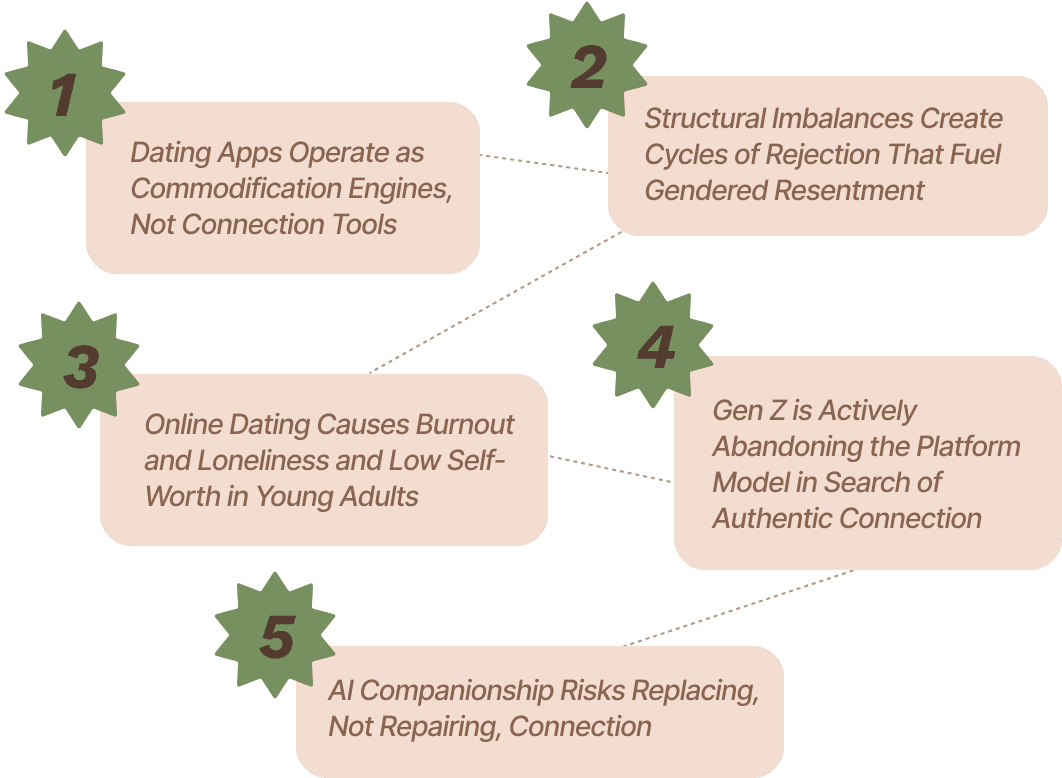
Our solution was formed on the basis of needing to address five key insights found within our research phase in order to successfully accommodate to the real-world needs of our user base.
The endless swiping featured within existing dating apps creates fatigue and dehumanises users, preventing the potential for meaningful digital connection.
We conducted further research to validate what we discovered through existing research. We noticed Gen Z collectively expressing a largely negative sentiment towards dating apps, perpetuating an overall negative stigma surrounding online dating culture whilst simultaneously expressing a desire for authentic, real-world community.
“On one hand, most single people I know are on the apps - but everyone has this idea that being on the apps is ‘cringe’ and meeting people on there is less genuine than meeting by chance in real life.” (Interviewee)
Target Demographic
Our target users are young Gen-Z adults that are fatigued by online dating. This audience is burnt out by the current model of existing solutions that commodify their users and force them to frequently experience cycles of constant rejection or ‘ghosting’. Circl alternatively seeks to meet their needs by providing the facilitation of real-life connections that are becoming increasingly replaced by solely digital interactions.
Meet Dean, our user persona we used to help us personalise and empathise with our target demographic.
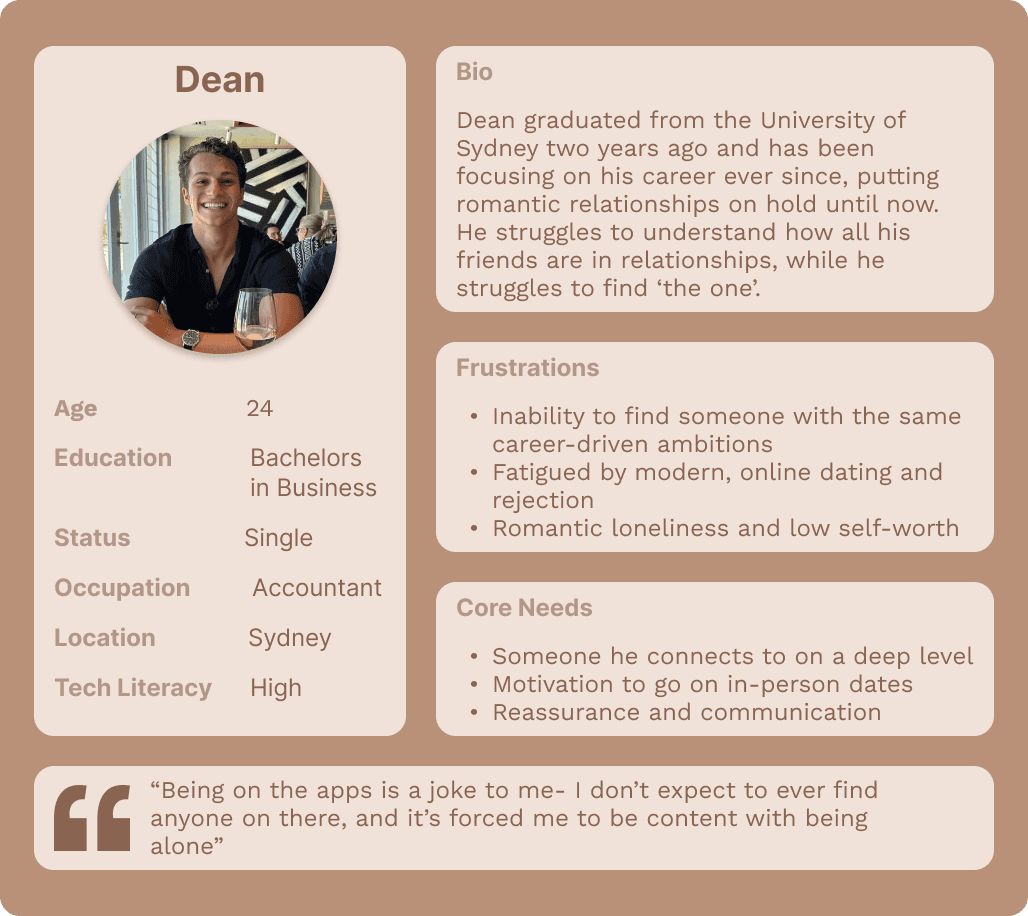
Circl has also considered the needs of the more extremist base of young adults that hold extremist ideologies stemming from gender-based resentment and those becoming more reliant on AI relationships. This has been addressed through a focus on guiding healthier processes of rejection and easing the transition from a digital platform to reduced-stress, real-life interactions.
Final Insights
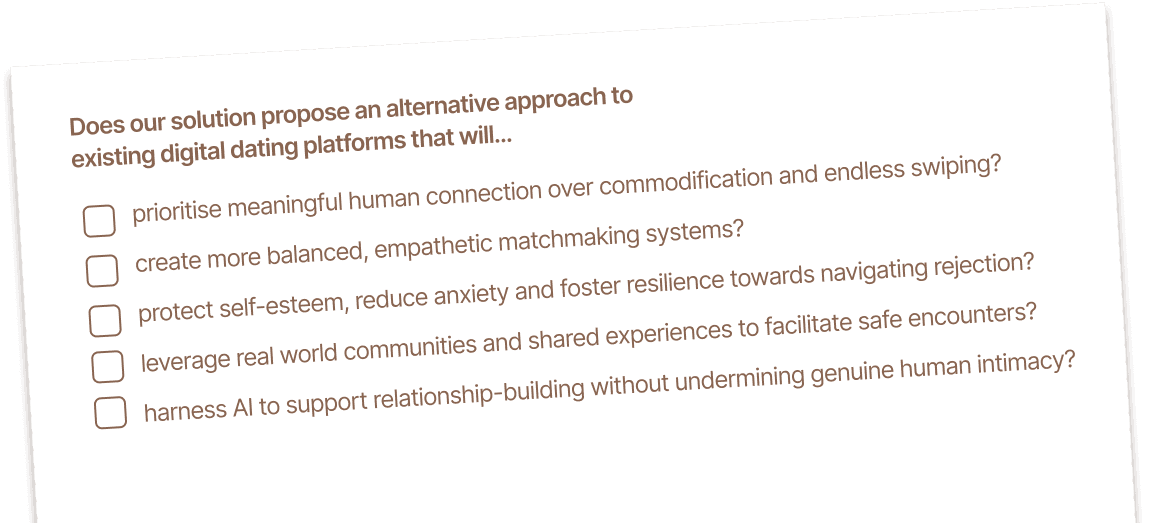
After condensing these findings into insights, we were able to form specific, defined criteria to follow when ideating a solution - ultimately creating a checklist of essential features and elements to ensure the effectiveness of our design solution in regards to the real-world needs of our target audience.
Design Solution
Features
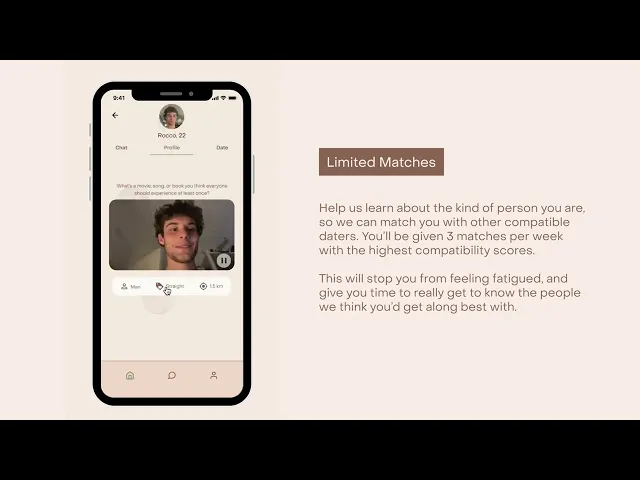
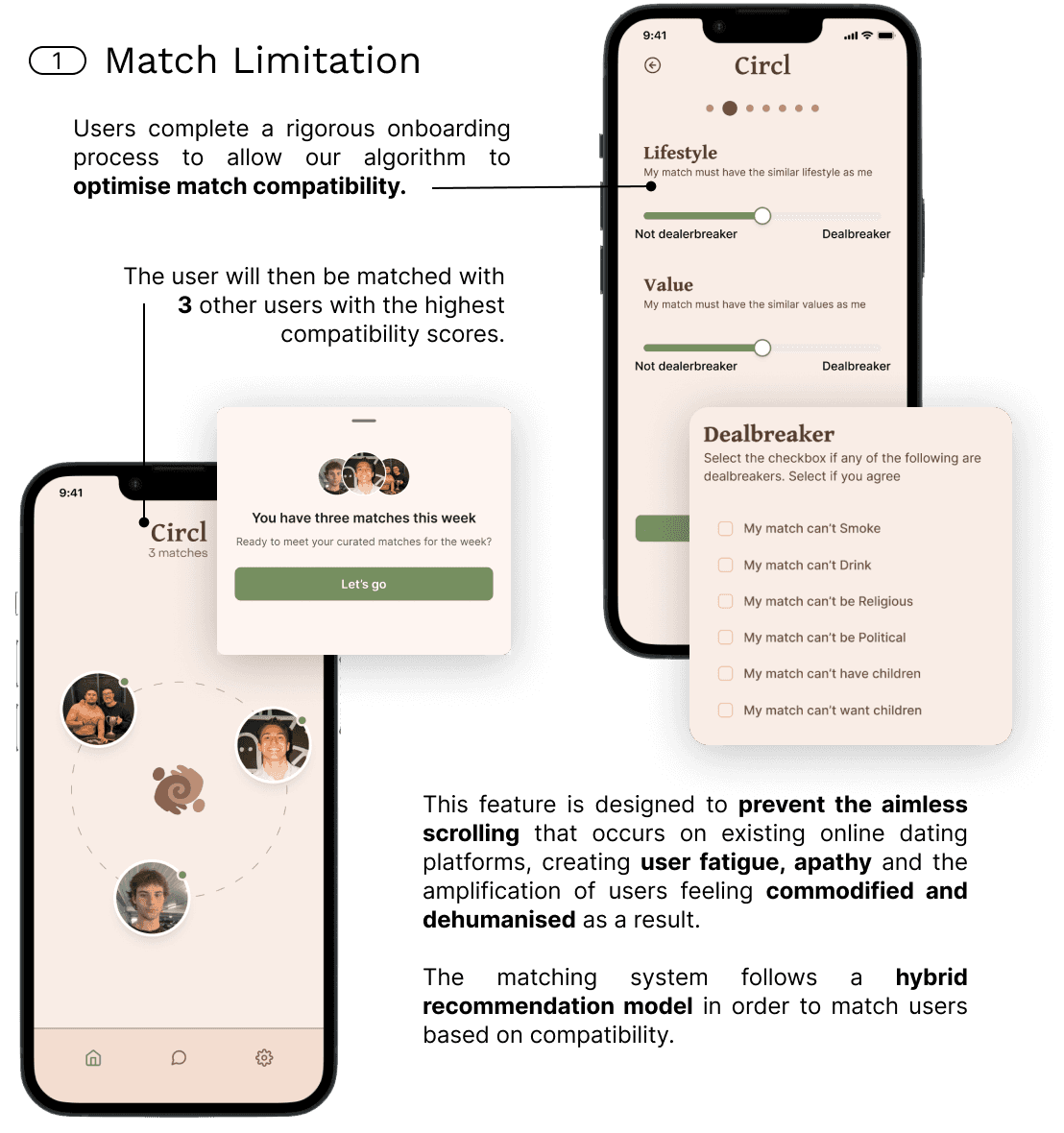
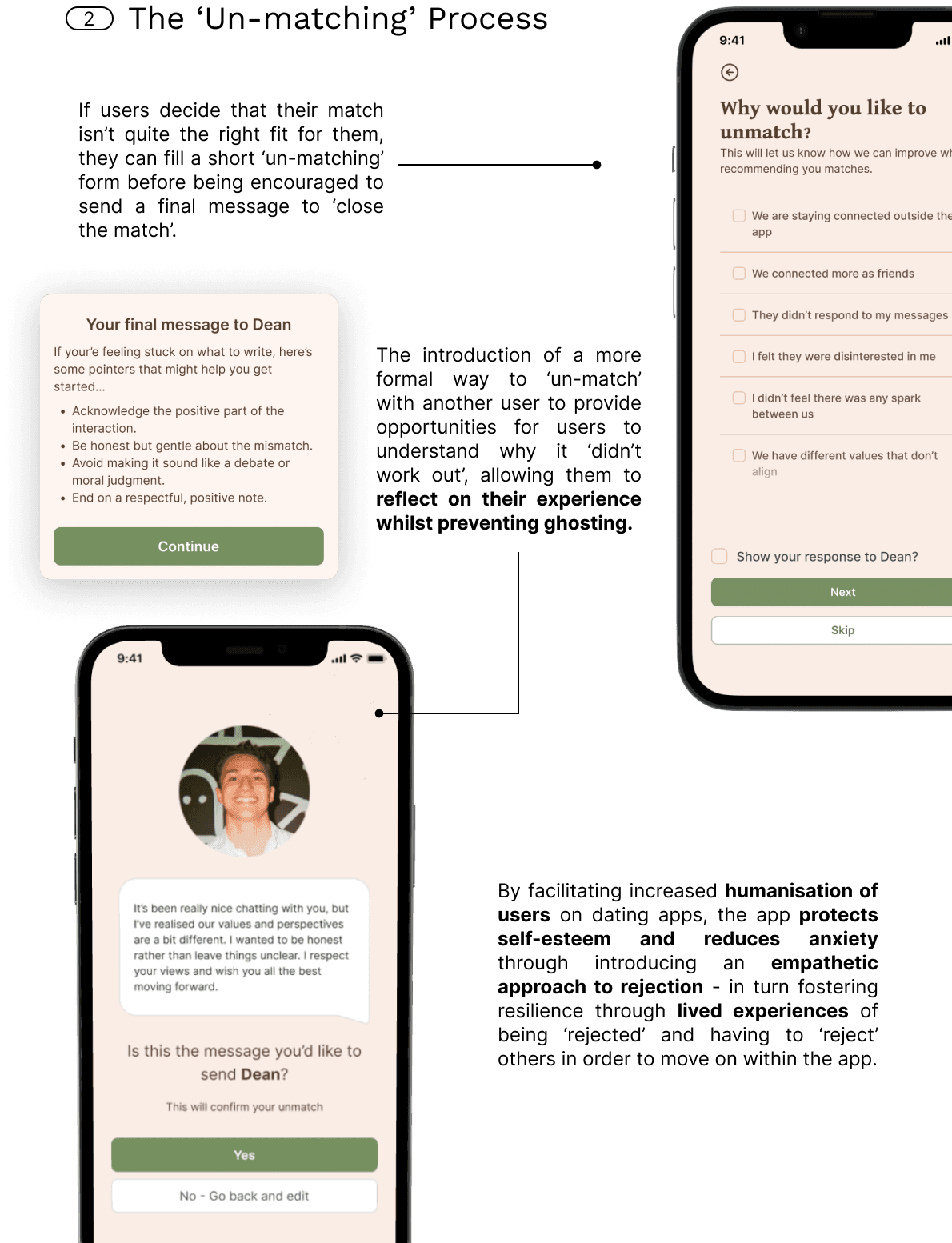
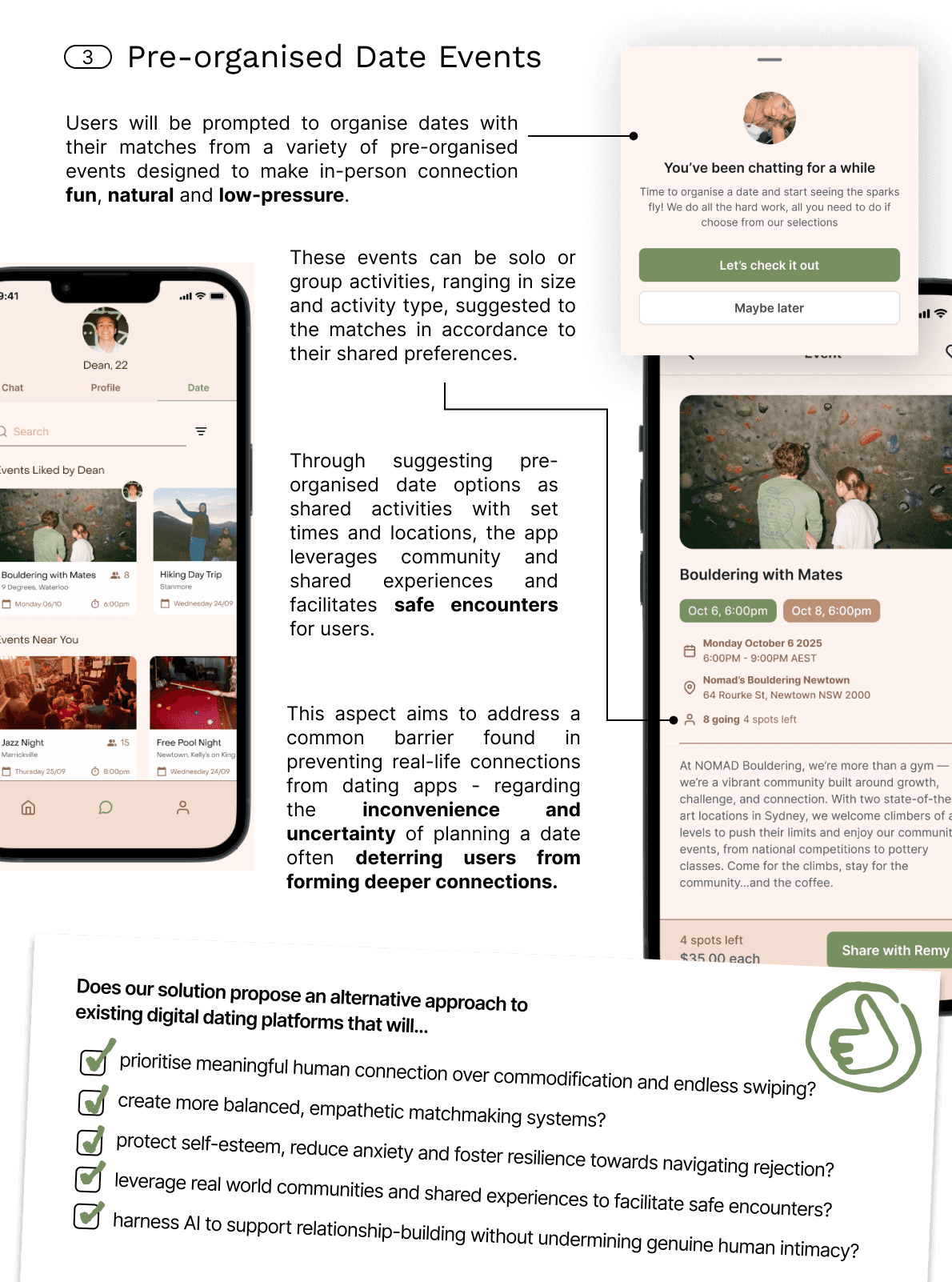
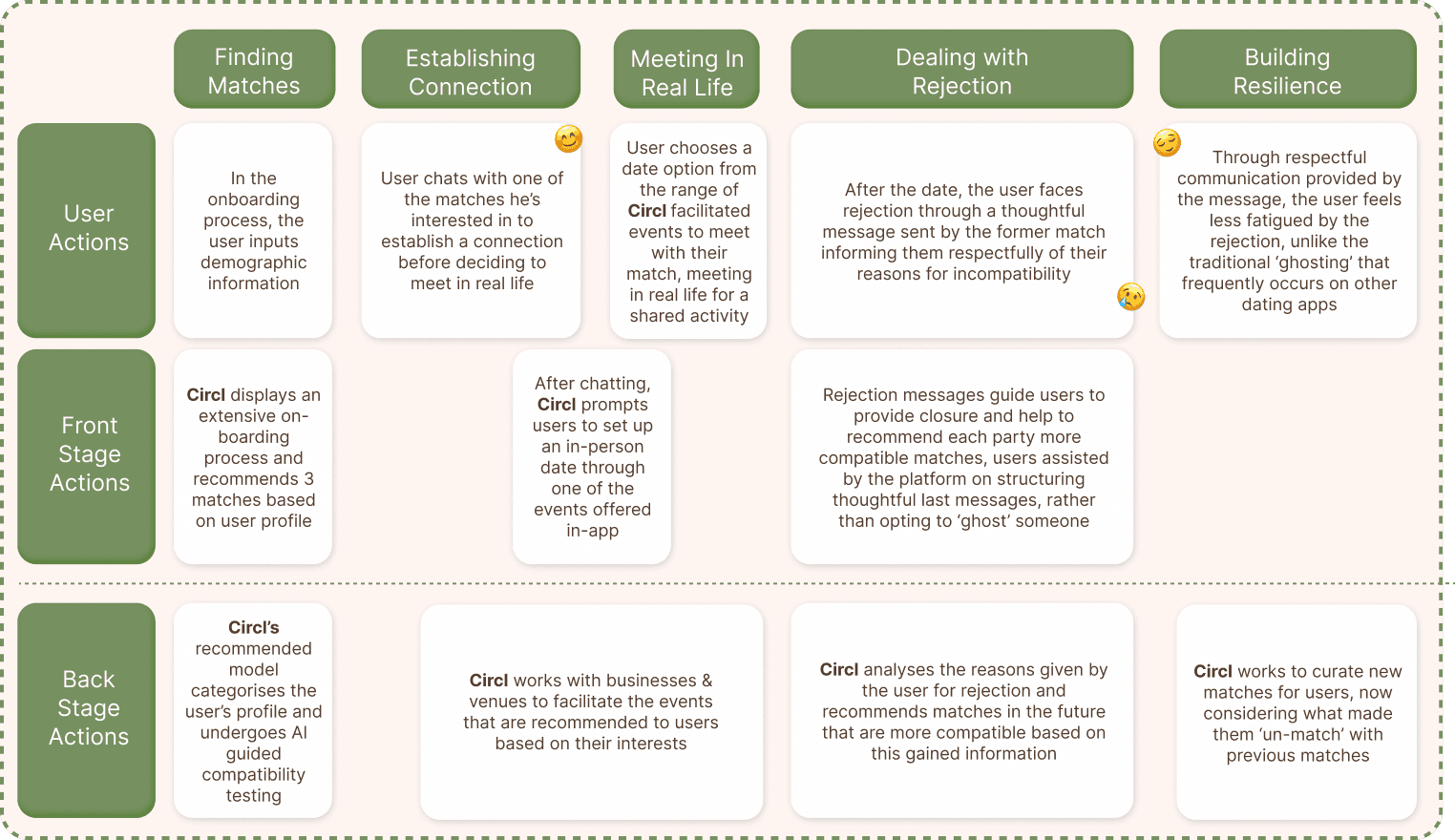
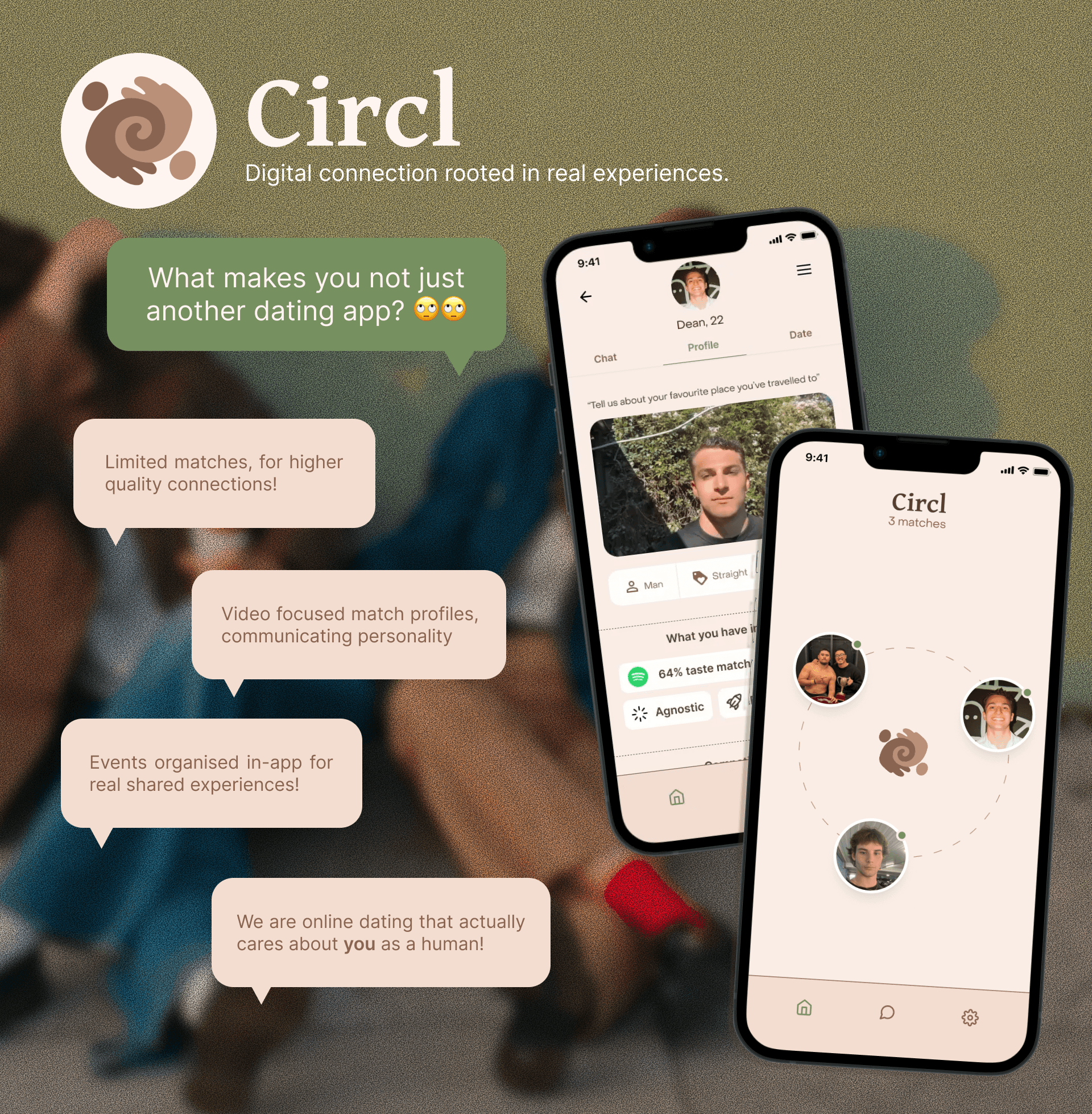
Therefore, our solution proposes a revised dating app aimed to redefine authentic digital connection through facilitating real-life interactions and breaking down existing stigma surrounding online dating. The app features three key points of differentiation; users will receive a limitation on the amount of matches they can view at once, the app will offer pre-organised date events for the user and their match to attend - and finally, the introduction of an ‘un-matching’ process.
User Journey Map
Development & Further Testing
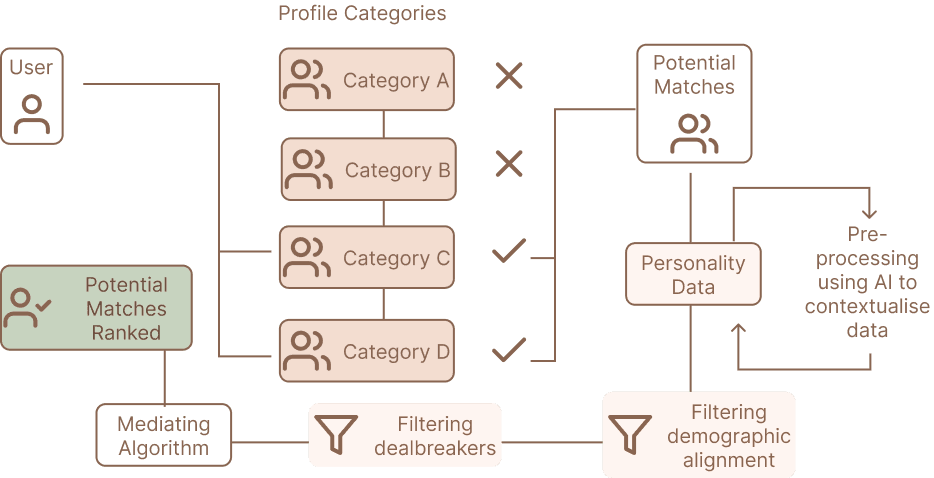
Circl recommendation system functionality
During user testing, we found that some participants were confused about the matching and curation process, so we decided to flesh out this process.
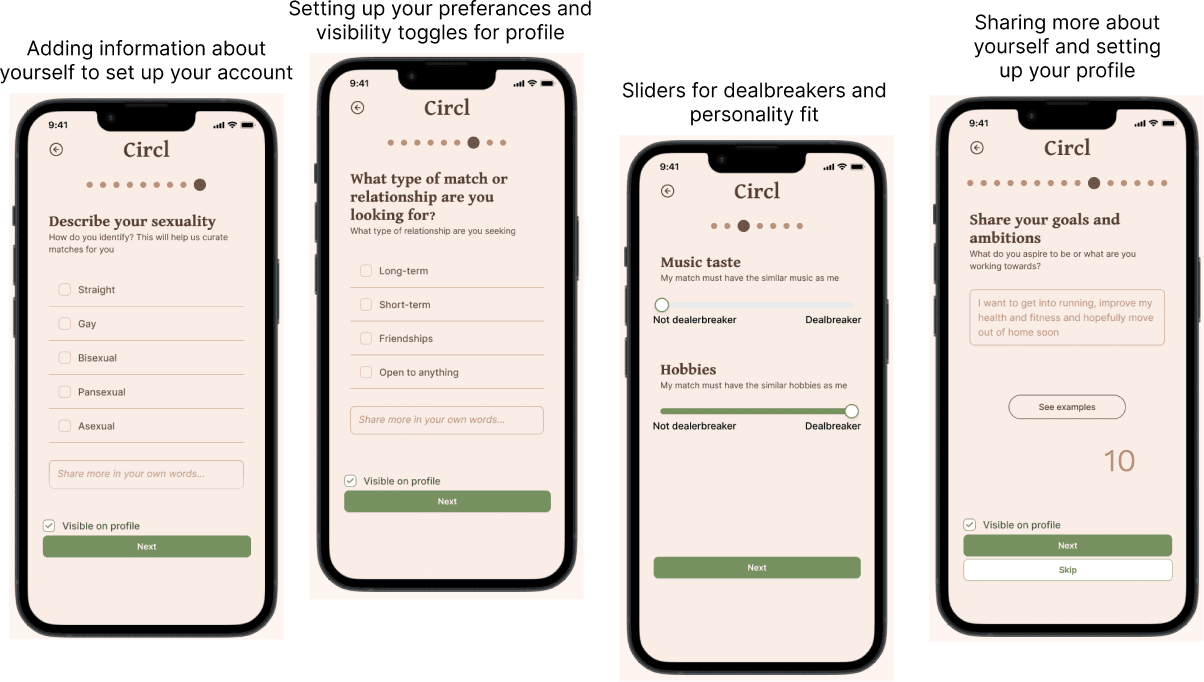
We created a back-end flow that undergoes a series of filtration processes to calculate the best matches. It begins with categorising the user based off demographical information, analysing and contextualising personality data using AI, filtering potential matches using dealbreaker information, and then a mediator algorithm processes and excludes or includes more profiles to create the final potential matches ranked in order of compatability. In oder to communicate this, we created an extensive onboarding process, which not only explains the process but allows the user to feel that they are providing yhe algorithm with ‘enough’ information to give them quality matches, as previously, they had only tested the video recording aspect of profile creation.
Profile viewing iteration
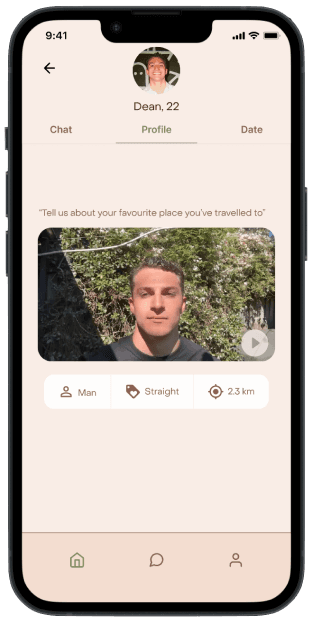
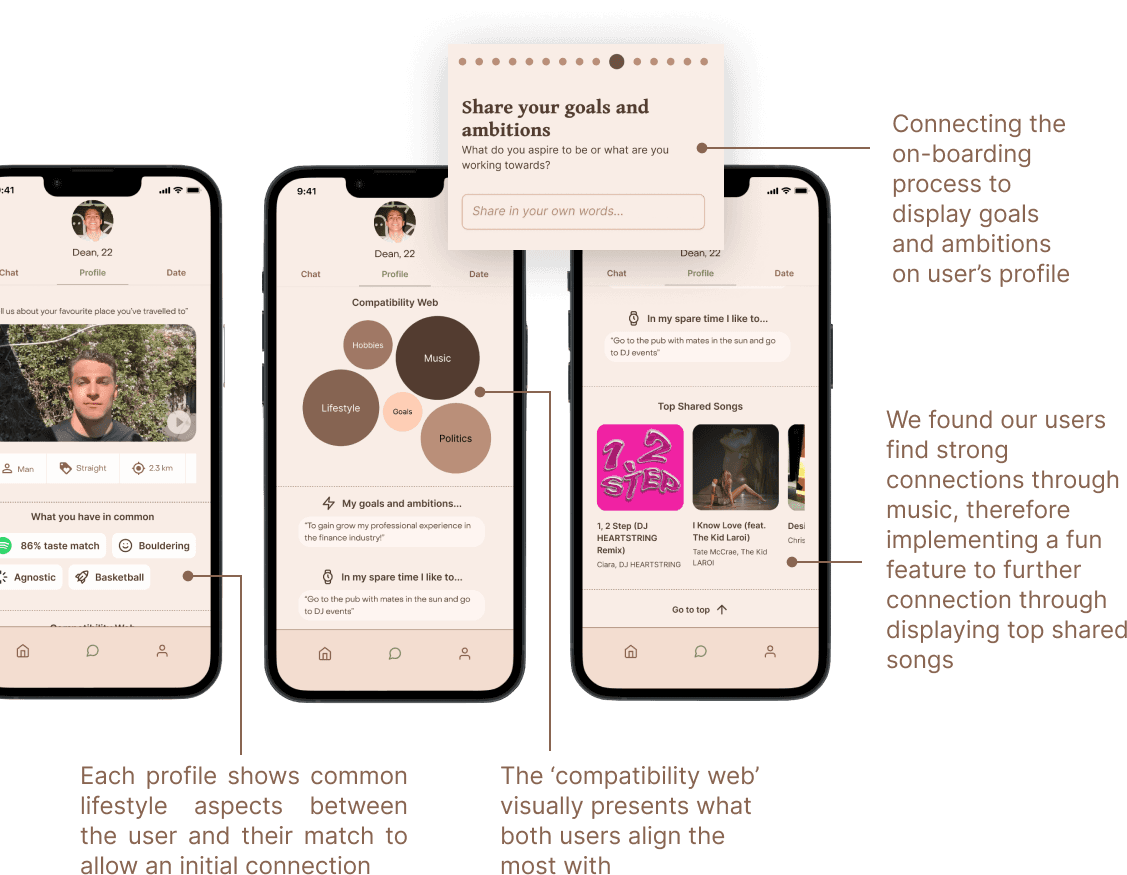
We found that although we received positive feedback of the centralisation of a introductory video as the main feature of the profile, the profile page was still lacking in other information. We wanted to differentiate ourselves further than generic dating apps such as Hinge, that already include video and voice prompt features.
In developing our back-end matching process in tandem with our on-boarding process, we wanted to introduce consistency and further personalisation to the profiles to allow users to gauge an even better understanding of their matches.
Pre iteration profile screen
Video focused profiles
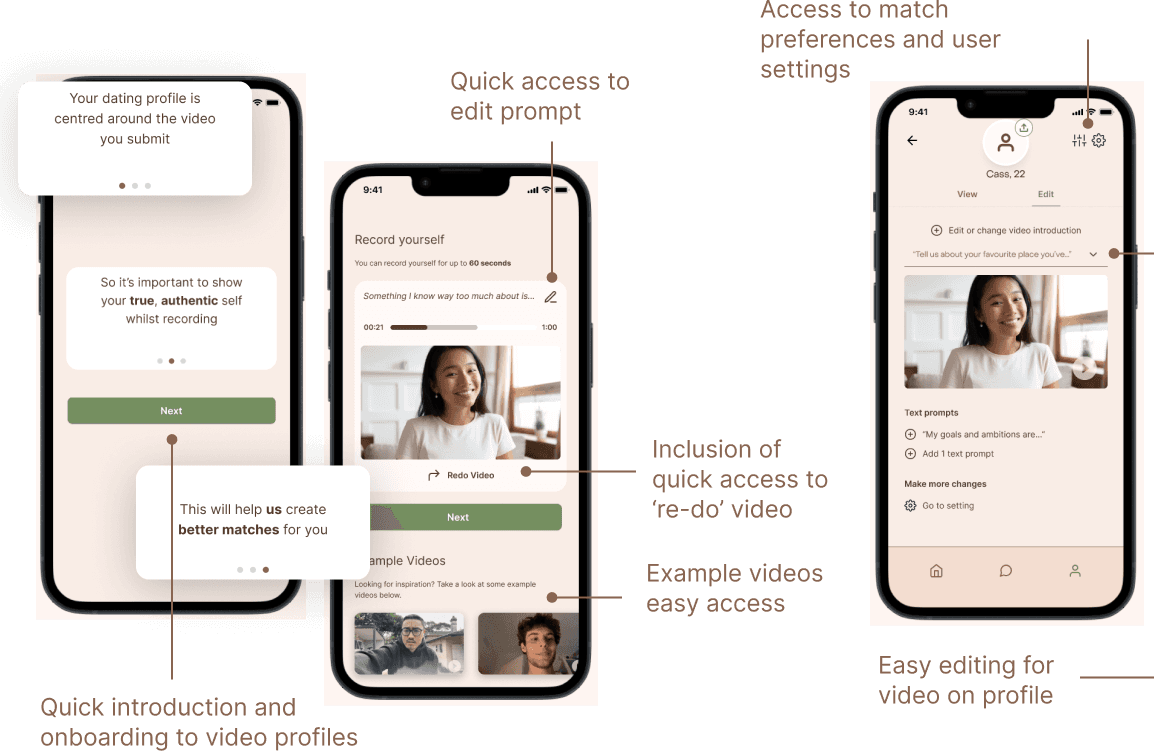
We hypothesised that video based profiles would help communicate a sense of genuineness and personality of matches, confirmed through our initial testing, however we found that users felt initially uncomfortable filming themselves. Prompts acted as a good first step in providing guidance but users felt as though they needed more.
Therefore, we followed Hinge’s approach to audio prompt recordings with providing examples. We tested this feature again with some further explanation, so users better understood the value and purpose of the video introduction. In our additional testing, we found this overall helped improved how comfortable users felt to record the video themselves.
This iteration was integrated into our new onboarding flow at the end, becoming the last stage before users complete their account creation.
Changes to un-matching process
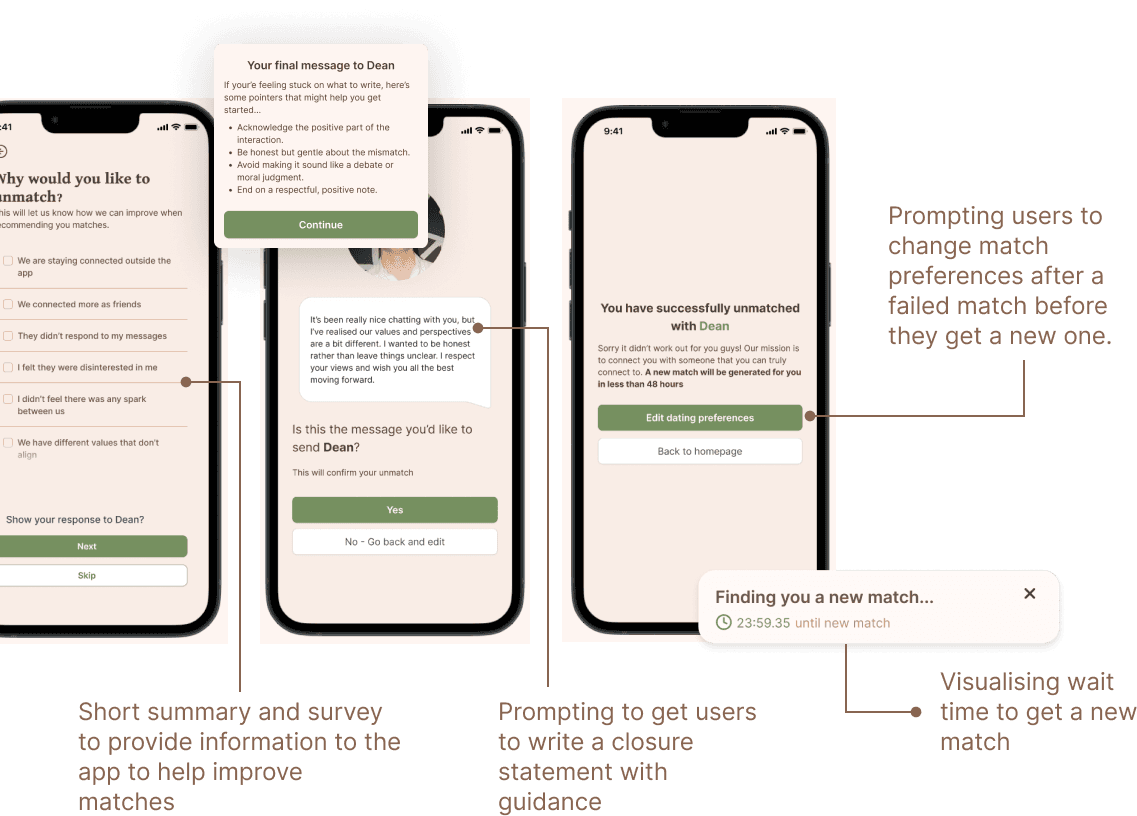
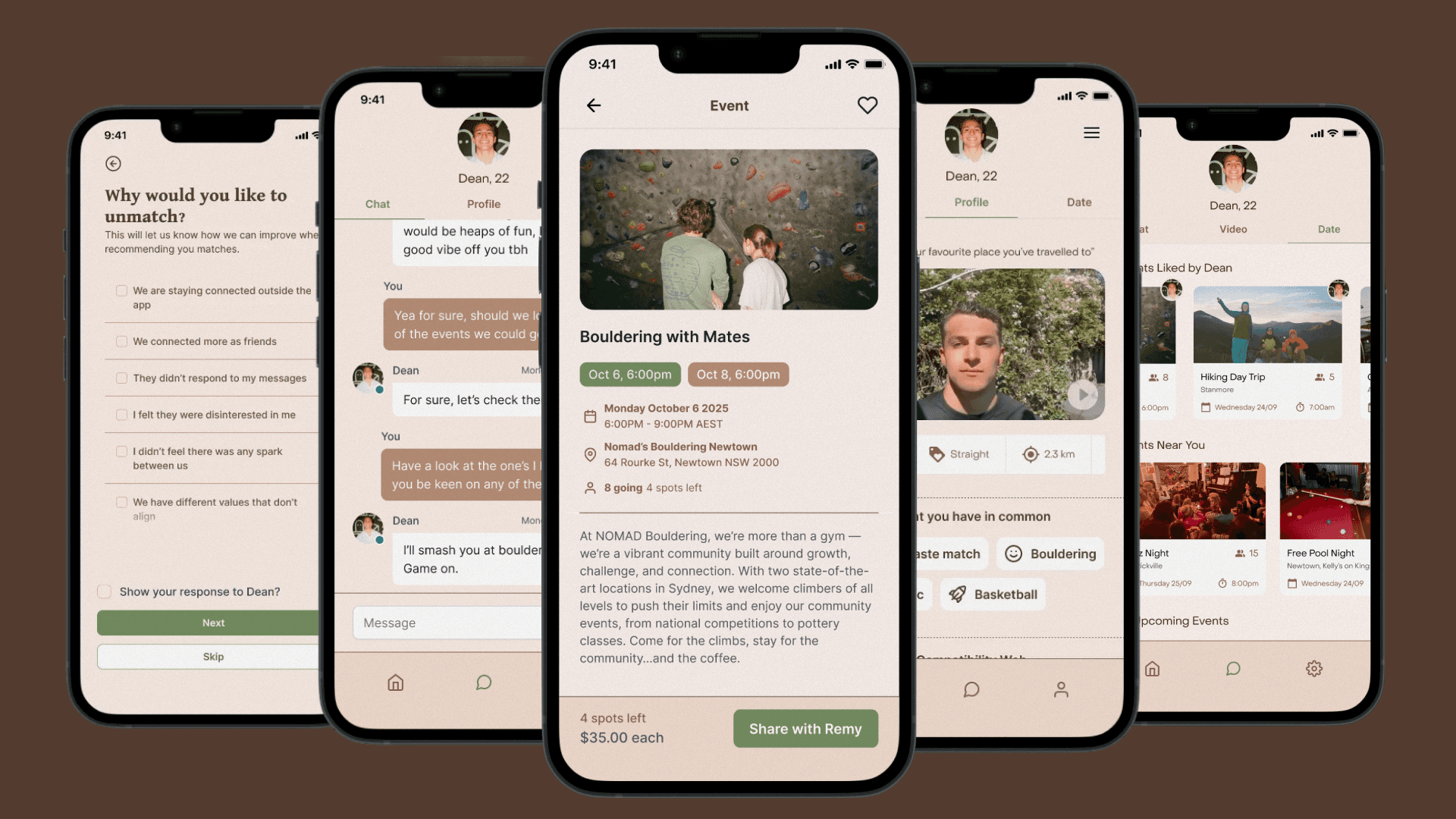
Another feature well received by users is how you need to un-match someone in order to move on and get more matches, alleviating ghosting and impersonal interactions. However, we didn’t initially test the full process, and the closure statements that we did test had some mixed perceptions. As well as this, the use of generated or AI closure statements undermined the core focus of Circl in promoting a sense of genuineness. Therefore, we needed to rework the solution and test it again with users.
The concept remained quite similar, users would complete a short survey but instead of the app providing its our statement to the user, the app helps guide and prompt users to write their own rejection to help people deal with the rejection. Optionally, the user can also share their answer in the survey to why they are un-matching them. This was well received by users, but the app could be more involved in this process and still provide a quite minimal closure statement if the user chooses to not write something themselves.
Iterations on Limited Matches
During the testing fair, we discovered some issues with our initial model and approach for matching users. Users would have three matches at any given time, and if you unmatched someone it would be refreshed weekly. Some felt that three matches was too much or too little, lacking flexibility, and the wait time to get a new match made people feel like they were wasting time.
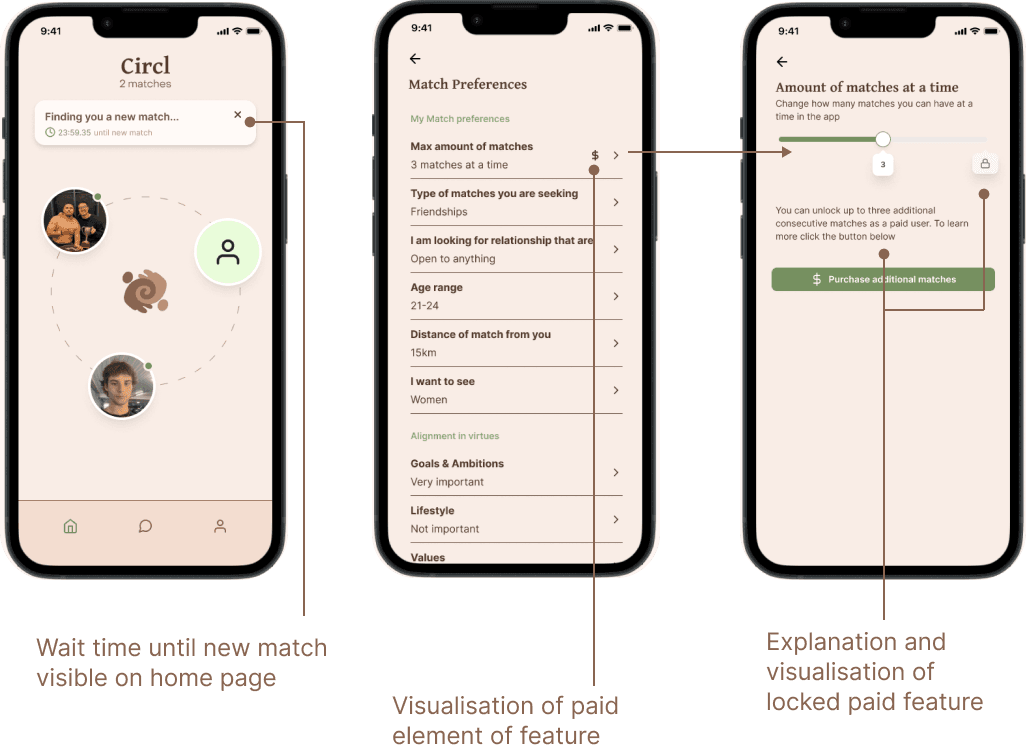
In order to address these problems without moving too far away from the core focus of our product, we included the option to change the quantity of matches they get from 1-3 and the option to pay to increase the match maximum to 6. This we felt helped to promote genuine interactions and authentic experiences. We didn’t want to write off the user pain point we identified, but wanted to discourage users to have more then three. Therefore we felt that the paywall was an effective way to achieve this, but would require further testing to affirm.
We also changed the duration to find new matches. We still needed to add a delay, especially to account for recommendation system, but also so that users felt the algorithm was finding quality matches for them. Instead of 7 days, which was too long, users would get their new matches within 24-48 hours.
Iterations on In-app Events
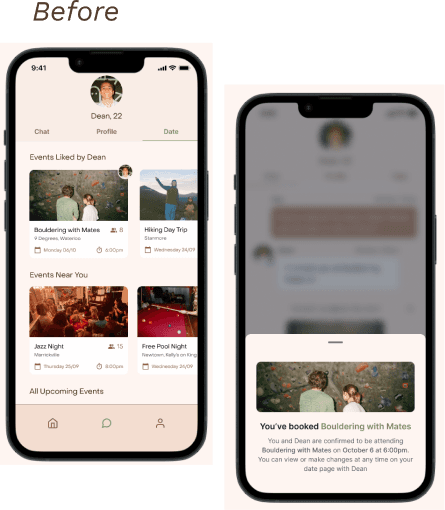
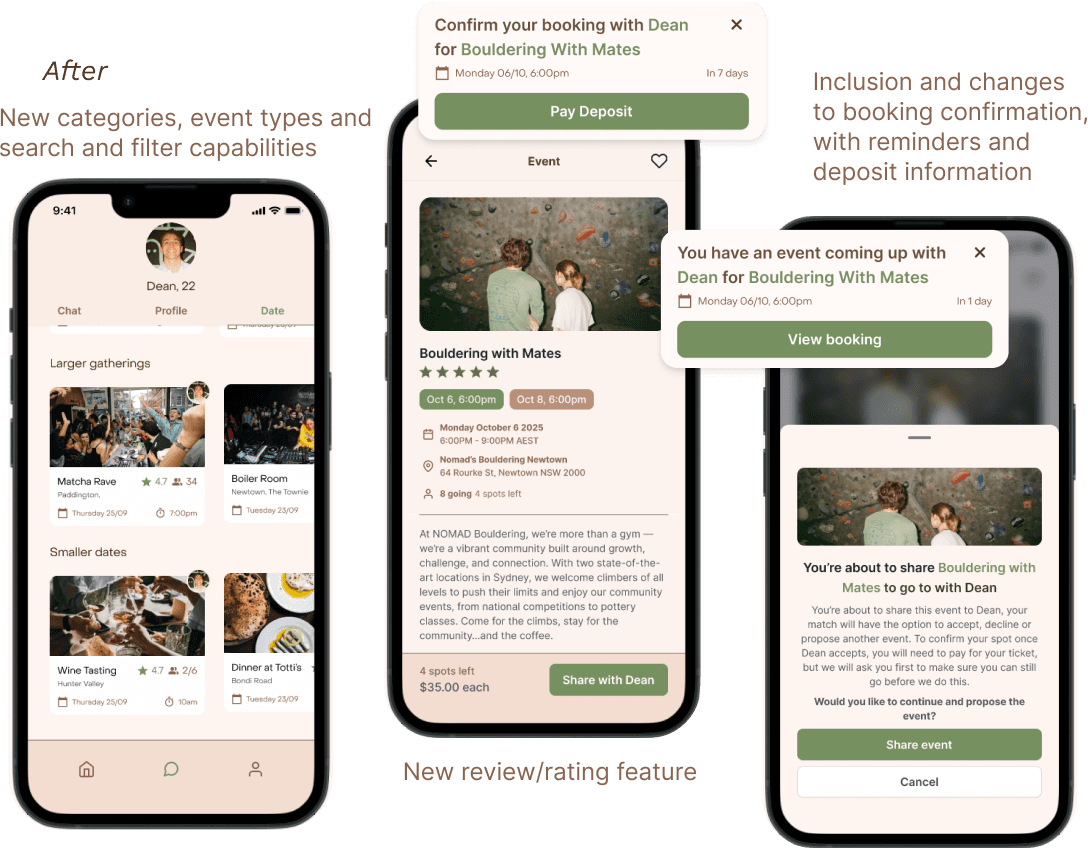
We also identified some changes necessary to our events. Although many liked the group event structure and ease of booking directly in the app, some people wanted more flexibility with more intimate date options. We included this change alongside search, filters, and new categories for more intimate dates, as well as larger community events. Another fear we found in testing stemmed from people being potentially ghosted in person. In order to address this, users would be required to pay in advance to confirm their booking for paid events. The app would then continue to remind users for upcoming events and nudge them afterwards to keep people accountable and review the event they attended.
Final Product
Product Video
Check out the final product through our promotional video, going through the experience of the application and various features
Financial Model
Alongside the recommendation system we developed, we also wanted to consider further feasibility in the next steps of Circl’s development through accounting for financial viability. As mentioned previously, we noticed that a core problem within existing apps is the commodification of their users, making love feel transactional (especially for their male audiences) - and therefore, we wanted to minimise this to avoid contradicting the initial aims and values of our solution.
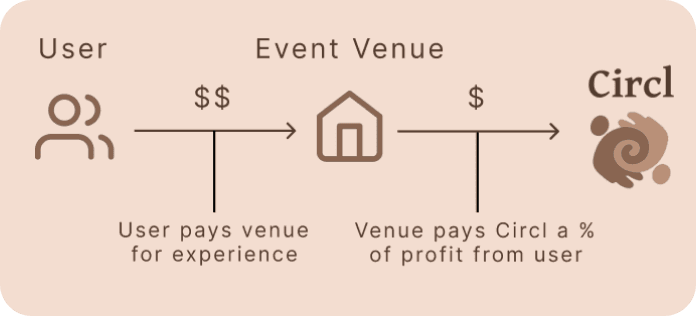
Due to our unique product offering, Circl can be funded instead through collaboration and affiliation with event venues and event hosts. We offer a strong value proposition to event hosts, as Circl can provide a healthy, consistent stream of customers to their venue. Users will pay the same for these events as usual, with Circl taking a small fee for each ticket sold from the event hosts. This model enables us to avoid pushing the cost of the app’s function onto our user base, whilst also deterring users from simply booking outside of the app - keeping Circl users both accountable and safe.
Rollout Strategy & Next Steps
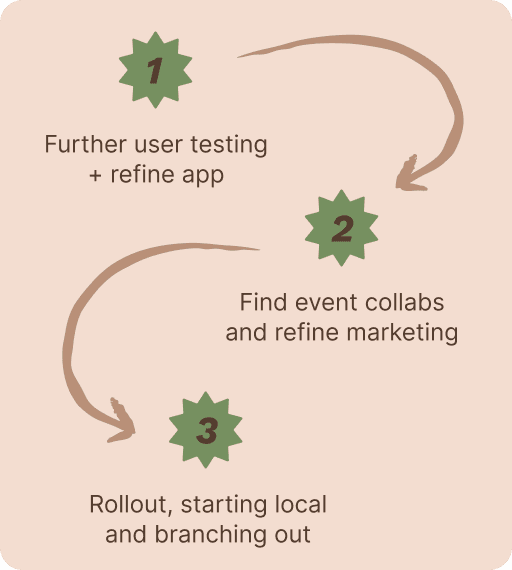
One of the key limitations and pain points that persists across all existing dating apps is the perceived quality of the dating pool. Like new dating app, establishing a strong user base would be difficult. To get the ‘right’ users, Circl would require an intensive Guerrilla marketing strategy, with in-person pop-ups and collaborations to expand the user base, focusing on small, local areas first before potentially expanding statewide where viable. As Circl limits the quantity of matches users can have at once (alongside the delay in receiving new matches and no ‘swiping’ browsing feature), we would require a significantly smaller starting user base compared to traditional dating apps.
Product Showcase
figma wizard
open to full-time opportunities in Brisbane / remote
4 internships landed during university
graduated nov 25 with Bachelor of Design (Interaction Design) from USYD
two years experience in product design
Circl
Digital connections rooted in real experiences
Capstone Project
Interaction Design
Mobile
Project Type
University
Role
Designer / UX Researcher
Timeline
3 months
Tools
Canva, Figma, Figjam, Figma Slides
Design methods / activities
Online Ethnography, Usability Testing, User Journey Mapping, HMWs, Personas, Data Analysis, Mobile Design, Marketing Strategy, Financial Modelling,
Collaborators
Kirita Geeves, Yasmine Harvey, Jessica Lee
Table of contents
Introduction to the problem
Design Solution
Development & Further testing
Final product
Introduction to the problem
The problem space
With the task brief of 'designing for transitions' our group was immediately drawn to discourse in our social circles with changes in romantic relationships and dating behaviours in relationship to the rise of technological advancements and social disruptions.
Existing solutions commodified dating with an endless cycle of swiping fueling gendered based resentment as women face safety concerns and harassment and men face endless cycles of rejection.
“Men outnumber women 3:1 on dating apps with male match rates averaging at 3%, transforming dating into a commodified marketplace of swipes and profiles. This highly competitive system subjects users to repeated cycles of rejection leading to resentment pushing people furt her into online communities, deepening division rather than fostering mutual understanding and authentic connections.”
Design rationale
Our solution was formed on the basis of needing to address five key insights found within our research phase in order to successfully accommodate to the real-world needs of our user base.
The endless swiping featured within existing dating apps creates fatigue and dehumanises users, preventing the potential for meaningful digital connection.
We conducted further research to validate what we discovered through existing research. We noticed Gen Z collectively expressing a largely negative sentiment towards dating apps, perpetuating an overall negative stigma surrounding online dating culture whilst simultaneously expressing a desire for authentic, real-world community.
“On one hand, most single people I know are on the apps - but everyone has this idea that being on the apps is ‘cringe’ and meeting people on there is less genuine than meeting by chance in real life.” (Interviewee)
Target Demographic
Our target users are young Gen-Z adults that are fatigued by online dating. This audience is burnt out by the current model of existing solutions that commodify their users and force them to frequently experience cycles of constant rejection or ‘ghosting’. Circl alternatively seeks to meet their needs by providing the facilitation of real-life connections that are becoming increasingly replaced by solely digital interactions.
Meet Dean, our user persona we used to help us personalise and empathise with our target demographic.
Circl has also considered the needs of the more extremist base of young adults that hold extremist ideologies stemming from gender-based resentment and those becoming more reliant on AI relationships. This has been addressed through a focus on guiding healthier processes of rejection and easing the transition from a digital platform to reduced-stress, real-life interactions.
Final Insights
After condensing these findings into insights, we were able to form specific, defined criteria to follow when ideating a solution - ultimately creating a checklist of essential features and elements to ensure the effectiveness of our design solution in regards to the real-world needs of our target audience.
Design Solution
Features
Therefore, our solution proposes a revised dating app aimed to redefine authentic digital connection through facilitating real-life interactions and breaking down existing stigma surrounding online dating. The app features three key points of differentiation; users will receive a limitation on the amount of matches they can view at once, the app will offer pre-organised date events for the user and their match to attend - and finally, the introduction of an ‘un-matching’ process.
User Journey Map
Development & Further Testing
Circl recommendation system functionality
During user testing, we found that some participants were confused about the matching and curation process, so we decided to flesh out this process.
We created a back-end flow that undergoes a series of filtration processes to calculate the best matches. It begins with categorising the user based off demographical information, analysing and contextualising personality data using AI, filtering potential matches using dealbreaker information, and then a mediator algorithm processes and excludes or includes more profiles to create the final potential matches ranked in order of compatability. In oder to communicate this, we created an extensive onboarding process, which not only explains the process but allows the user to feel that they are providing yhe algorithm with ‘enough’ information to give them quality matches, as previously, they had only tested the video recording aspect of profile creation.
Profile viewing iteration
We found that although we received positive feedback of the centralisation of a introductory video as the main feature of the profile, the profile page was still lacking in other information. We wanted to differentiate ourselves further than generic dating apps such as Hinge, that already include video and voice prompt features.
In developing our back-end matching process in tandem with our on-boarding process, we wanted to introduce consistency and further personalisation to the profiles to allow users to gauge an even better understanding of their matches.
Pre iteration profile screen
Video focused profiles
We hypothesised that video based profiles would help communicate a sense of genuineness and personality of matches, confirmed through our initial testing, however we found that users felt initially uncomfortable filming themselves. Prompts acted as a good first step in providing guidance but users felt as though they needed more.
Therefore, we followed Hinge’s approach to audio prompt recordings with providing examples. We tested this feature again with some further explanation, so users better understood the value and purpose of the video introduction. In our additional testing, we found this overall helped improved how comfortable users felt to record the video themselves.
This iteration was integrated into our new onboarding flow at the end, becoming the last stage before users complete their account creation.
Changes to un-matching process
Another feature well received by users is how you need to un-match someone in order to move on and get more matches, alleviating ghosting and impersonal interactions. However, we didn’t initially test the full process, and the closure statements that we did test had some mixed perceptions. As well as this, the use of generated or AI closure statements undermined the core focus of Circl in promoting a sense of genuineness. Therefore, we needed to rework the solution and test it again with users.
The concept remained quite similar, users would complete a short survey but instead of the app providing its our statement to the user, the app helps guide and prompt users to write their own rejection to help people deal with the rejection. Optionally, the user can also share their answer in the survey to why they are un-matching them. This was well received by users, but the app could be more involved in this process and still provide a quite minimal closure statement if the user chooses to not write something themselves.
Iterations on Limited Matches
During the testing fair, we discovered some issues with our initial model and approach for matching users. Users would have three matches at any given time, and if you unmatched someone it would be refreshed weekly. Some felt that three matches was too much or too little, lacking flexibility, and the wait time to get a new match made people feel like they were wasting time.
In order to address these problems without moving too far away from the core focus of our product, we included the option to change the quantity of matches they get from 1-3 and the option to pay to increase the match maximum to 6. This we felt helped to promote genuine interactions and authentic experiences. We didn’t want to write off the user pain point we identified, but wanted to discourage users to have more then three. Therefore we felt that the paywall was an effective way to achieve this, but would require further testing to affirm.
We also changed the duration to find new matches. We still needed to add a delay, especially to account for recommendation system, but also so that users felt the algorithm was finding quality matches for them. Instead of 7 days, which was too long, users would get their new matches within 24-48 hours.
Iterations on In-app Events
We also identified some changes necessary to our events. Although many liked the group event structure and ease of booking directly in the app, some people wanted more flexibility with more intimate date options. We included this change alongside search, filters, and new categories for more intimate dates, as well as larger community events. Another fear we found in testing stemmed from people being potentially ghosted in person. In order to address this, users would be required to pay in advance to confirm their booking for paid events. The app would then continue to remind users for upcoming events and nudge them afterwards to keep people accountable and review the event they attended.
Final Product
Product Video
Check out the final product through our promotional video, going through the experience of the application and various features
Financial Model
Alongside the recommendation system we developed, we also wanted to consider further feasibility in the next steps of Circl’s development through accounting for financial viability. As mentioned previously, we noticed that a core problem within existing apps is the commodification of their users, making love feel transactional (especially for their male audiences) - and therefore, we wanted to minimise this to avoid contradicting the initial aims and values of our solution.
Due to our unique product offering, Circl can be funded instead through collaboration and affiliation with event venues and event hosts. We offer a strong value proposition to event hosts, as Circl can provide a healthy, consistent stream of customers to their venue. Users will pay the same for these events as usual, with Circl taking a small fee for each ticket sold from the event hosts. This model enables us to avoid pushing the cost of the app’s function onto our user base, whilst also deterring users from simply booking outside of the app - keeping Circl users both accountable and safe.
Rollout Strategy & Next Steps
One of the key limitations and pain points that persists across all existing dating apps is the perceived quality of the dating pool. Like new dating app, establishing a strong user base would be difficult. To get the ‘right’ users, Circl would require an intensive Guerrilla marketing strategy, with in-person pop-ups and collaborations to expand the user base, focusing on small, local areas first before potentially expanding statewide where viable. As Circl limits the quantity of matches users can have at once (alongside the delay in receiving new matches and no ‘swiping’ browsing feature), we would require a significantly smaller starting user base compared to traditional dating apps.
Product Showcase
figma wizard
open to full-time opportunities in Brisbane / remote
4 internships landed during university
graduated nov 25 with Bachelor of Design (Interaction Design) from USYD
two years experience in product design
Circl
Digital connections rooted in real experiences
Capstone Project
Interaction Design
Mobile
Project Type
University
Role
Designer / UX Researcher
Timeline
3 months
Tools
Canva, Figma, Figjam, Figma Slides
Design methods / activities
Online Ethnography, Usability Testing, User Journey Mapping, HMWs, Personas, Data Analysis, Mobile Design, Marketing Strategy, Financial Modelling,
Collaborators
Kirita Geeves, Yasmine Harvey, Jessica Lee
Table of contents
Introduction to the problem
Design Solution
Development & Further testing
Final product
Introduction to the problem
The problem space
With the task brief of 'designing for transitions' our group was immediately drawn to discourse in our social circles with changes in romantic relationships and dating behaviours in relationship to the rise of technological advancements and social disruptions.
Existing solutions commodified dating with an endless cycle of swiping fueling gendered based resentment as women face safety concerns and harassment and men face endless cycles of rejection.
“Men outnumber women 3:1 on dating apps with male match rates averaging at 3%, transforming dating into a commodified marketplace of swipes and profiles. This highly competitive system subjects users to repeated cycles of rejection leading to resentment pushing people furt her into online communities, deepening division rather than fostering mutual understanding and authentic connections.”
Design rationale
Our solution was formed on the basis of needing to address five key insights found within our research phase in order to successfully accommodate to the real-world needs of our user base.
The endless swiping featured within existing dating apps creates fatigue and dehumanises users, preventing the potential for meaningful digital connection.
We conducted further research to validate what we discovered through existing research. We noticed Gen Z collectively expressing a largely negative sentiment towards dating apps, perpetuating an overall negative stigma surrounding online dating culture whilst simultaneously expressing a desire for authentic, real-world community.
“On one hand, most single people I know are on the apps - but everyone has this idea that being on the apps is ‘cringe’ and meeting people on there is less genuine than meeting by chance in real life.” (Interviewee)
Target Demographic
Our target users are young Gen-Z adults that are fatigued by online dating. This audience is burnt out by the current model of existing solutions that commodify their users and force them to frequently experience cycles of constant rejection or ‘ghosting’. Circl alternatively seeks to meet their needs by providing the facilitation of real-life connections that are becoming increasingly replaced by solely digital interactions.
Meet Dean, our user persona we used to help us personalise and empathise with our target demographic.
Circl has also considered the needs of the more extremist base of young adults that hold extremist ideologies stemming from gender-based resentment and those becoming more reliant on AI relationships. This has been addressed through a focus on guiding healthier processes of rejection and easing the transition from a digital platform to reduced-stress, real-life interactions.
Final Insights
After condensing these findings into insights, we were able to form specific, defined criteria to follow when ideating a solution - ultimately creating a checklist of essential features and elements to ensure the effectiveness of our design solution in regards to the real-world needs of our target audience.
Design Solution
Features
Therefore, our solution proposes a revised dating app aimed to redefine authentic digital connection through facilitating real-life interactions and breaking down existing stigma surrounding online dating. The app features three key points of differentiation; users will receive a limitation on the amount of matches they can view at once, the app will offer pre-organised date events for the user and their match to attend - and finally, the introduction of an ‘un-matching’ process.
User Journey Map
Development & Further Testing
Circl recommendation system functionality
During user testing, we found that some participants were confused about the matching and curation process, so we decided to flesh out this process.
We created a back-end flow that undergoes a series of filtration processes to calculate the best matches. It begins with categorising the user based off demographical information, analysing and contextualising personality data using AI, filtering potential matches using dealbreaker information, and then a mediator algorithm processes and excludes or includes more profiles to create the final potential matches ranked in order of compatability. In oder to communicate this, we created an extensive onboarding process, which not only explains the process but allows the user to feel that they are providing yhe algorithm with ‘enough’ information to give them quality matches, as previously, they had only tested the video recording aspect of profile creation.
Profile viewing iteration
We found that although we received positive feedback of the centralisation of a introductory video as the main feature of the profile, the profile page was still lacking in other information. We wanted to differentiate ourselves further than generic dating apps such as Hinge, that already include video and voice prompt features.
In developing our back-end matching process in tandem with our on-boarding process, we wanted to introduce consistency and further personalisation to the profiles to allow users to gauge an even better understanding of their matches.
Pre iteration profile screen
Video focused profiles
We hypothesised that video based profiles would help communicate a sense of genuineness and personality of matches, confirmed through our initial testing, however we found that users felt initially uncomfortable filming themselves. Prompts acted as a good first step in providing guidance but users felt as though they needed more.
Therefore, we followed Hinge’s approach to audio prompt recordings with providing examples. We tested this feature again with some further explanation, so users better understood the value and purpose of the video introduction. In our additional testing, we found this overall helped improved how comfortable users felt to record the video themselves.
This iteration was integrated into our new onboarding flow at the end, becoming the last stage before users complete their account creation.
Changes to un-matching process
Another feature well received by users is how you need to un-match someone in order to move on and get more matches, alleviating ghosting and impersonal interactions. However, we didn’t initially test the full process, and the closure statements that we did test had some mixed perceptions. As well as this, the use of generated or AI closure statements undermined the core focus of Circl in promoting a sense of genuineness. Therefore, we needed to rework the solution and test it again with users.
The concept remained quite similar, users would complete a short survey but instead of the app providing its our statement to the user, the app helps guide and prompt users to write their own rejection to help people deal with the rejection. Optionally, the user can also share their answer in the survey to why they are un-matching them. This was well received by users, but the app could be more involved in this process and still provide a quite minimal closure statement if the user chooses to not write something themselves.
Iterations on Limited Matches
During the testing fair, we discovered some issues with our initial model and approach for matching users. Users would have three matches at any given time, and if you unmatched someone it would be refreshed weekly. Some felt that three matches was too much or too little, lacking flexibility, and the wait time to get a new match made people feel like they were wasting time.
In order to address these problems without moving too far away from the core focus of our product, we included the option to change the quantity of matches they get from 1-3 and the option to pay to increase the match maximum to 6. This we felt helped to promote genuine interactions and authentic experiences. We didn’t want to write off the user pain point we identified, but wanted to discourage users to have more then three. Therefore we felt that the paywall was an effective way to achieve this, but would require further testing to affirm.
We also changed the duration to find new matches. We still needed to add a delay, especially to account for recommendation system, but also so that users felt the algorithm was finding quality matches for them. Instead of 7 days, which was too long, users would get their new matches within 24-48 hours.
Iterations on In-app Events
We also identified some changes necessary to our events. Although many liked the group event structure and ease of booking directly in the app, some people wanted more flexibility with more intimate date options. We included this change alongside search, filters, and new categories for more intimate dates, as well as larger community events. Another fear we found in testing stemmed from people being potentially ghosted in person. In order to address this, users would be required to pay in advance to confirm their booking for paid events. The app would then continue to remind users for upcoming events and nudge them afterwards to keep people accountable and review the event they attended.
Final Product
Product Video
Check out the final product through our promotional video, going through the experience of the application and various features
Financial Model
Alongside the recommendation system we developed, we also wanted to consider further feasibility in the next steps of Circl’s development through accounting for financial viability. As mentioned previously, we noticed that a core problem within existing apps is the commodification of their users, making love feel transactional (especially for their male audiences) - and therefore, we wanted to minimise this to avoid contradicting the initial aims and values of our solution.
Due to our unique product offering, Circl can be funded instead through collaboration and affiliation with event venues and event hosts. We offer a strong value proposition to event hosts, as Circl can provide a healthy, consistent stream of customers to their venue. Users will pay the same for these events as usual, with Circl taking a small fee for each ticket sold from the event hosts. This model enables us to avoid pushing the cost of the app’s function onto our user base, whilst also deterring users from simply booking outside of the app - keeping Circl users both accountable and safe.
Rollout Strategy & Next Steps
One of the key limitations and pain points that persists across all existing dating apps is the perceived quality of the dating pool. Like new dating app, establishing a strong user base would be difficult. To get the ‘right’ users, Circl would require an intensive Guerrilla marketing strategy, with in-person pop-ups and collaborations to expand the user base, focusing on small, local areas first before potentially expanding statewide where viable. As Circl limits the quantity of matches users can have at once (alongside the delay in receiving new matches and no ‘swiping’ browsing feature), we would require a significantly smaller starting user base compared to traditional dating apps.
Product Showcase
figma wizard
open to full-time opportunities in Brisbane / remote
4 internships landed during university
graduated nov 25 with Bachelor of Design (Interaction Design) from USYD
two years experience in product design